Paris Photo's digital sector places AI and CGI imagery inside photography's own history, and makes a case for "soft photography" as a useful term.
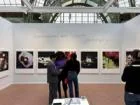
The digital sector at Paris Photo is small, but it's making a bigger argument than most of the fair's main floor. Now in its fourth edition, the section has 12 exhibitors this year and sits in the Grand Palais until 15 November, during the fair's 29th edition. Its curator, Marco De Mutiis of the Fotomuseum Winterthur, took over from Nina Roehrs, who led the first three iterations. The sector's central claim is that digital image-making isn't a sudden break from photography. It has a longer history than the current AI debate suggests, and the fair is trying to show that.
A teaching show inside the fair
The sector comes with a pedagogical exhibition called Soft Photography, organised by the École Cantonale d'Art de Lausanne in Switzerland. It looks at where AI and CGI sit within photography, and it's built as both an interactive exhibition and a series of talks. Its real aim is dialogue. Photography has long divided itself into analogue and digital camps, and the two rarely sit at the same table. Soft Photography tries to seat them together, and that's the most useful thing happening in this part of the fair.
The show also gives the sector a reason to exist. Without that framing, the digital section could look like a grab bag of anything on a screen. With it, the work reads as a continuing conversation about how images get made.
Where the categories blur
The sector does contain AI-generated imagery. New York's Heft Gallery presents Alkan Avcıoğlu's Disreality series, which extends the surreal aesthetic he first developed in a collaboration with Edward Burtynsky. The work is slick and strange, and it's clearly made with machine tools.
But the boundaries get fuzzy fast. Plenty of the sector's exhibitors show analogue work too, including photograms. That raises an obvious question: how much of a separate section is this, really? A similar problem surfaced in the Zero 10 sector at Art Basel's Swiss fair last June, where "digital art" stretched so far that it made you wonder whether it deserved its own zone at all. Paris Photo hasn't fully solved this, but its mix of media makes the point that the category is more porous than the labels suggest.
Standout presentations
Venezuelan gallery Carmen Araujo Arte is showing Alejandro Cartagena's mosaic-cut collages. Each one is built from found photographs, which makes the works a hand-made version of how generative AI assembles images from gathered pixels. They raise real questions about authorship. They also show, in a quietly affectionate way, how different human image-making is from algorithmic process. The results are intimate and hard to walk past.
Palo Gallery's booth is one of the more unsettling stands. It features work by the artist duo Andrea Orejarena and Caleb Stein from their American Glitch series, which questions simulation theory and the nature of a screen-saturated life. The tone sits somewhere between David Lynch's Twin Peaks and surveillance footage. The highlight is Glitch Typologies (2020-24), a seven-channel sequence of floating images projected onto the walls of a 3m-by-3m glass cube. The projectors hang from a rod at the centre, and they look a lot like CCTV cameras. At a moment of deep cultural cynicism, the piece is a reminder that photography and technology can still be playful, paranoid and surprising at once.
Yumo Wu's solo stand with Licheng Ling Projects might be the best example of the sector's central idea. Wu combines AI and darkroom manipulation, and the images are arranged so that technique, while it does create a sense of wonder, takes a back seat to the image itself. Viewers are asked to look at abstract textures rather than to puzzle over what's real and how it was made. It's her first solo presentation in Europe. One of her images, Old Dream No.1 (2026), is also included in Paris Photo's selection marking the bicentennial of photography's invention. She's an emerging artist, and her willingness to experiment cuts through the noise.
Vincent Fournier's Flora Incognita, presented by Au Cube, is a different kind of strange. The large portraits show speculative flowers derived from real plants, altered to imagine how they might look on another planet, under different radiation or gravity. They may read as AI images at first glance, but Fournier made them with CGI in Houdini, a software that's fairly old by current standards. Each print sits in a wooden frame with a golden plaque naming the plant. That choice recalls 18th- and 19th-century botanical illustration, and the Grand Palais suits it well, since its architecture belongs to an era of scientific curiosity.
Nguyen-Wahed, a New York gallery, devotes its solo stand to Los Angeles-based photographer Summer Wagner. The unframed, large-scale photographs are romantic, grainy and densely textured, with cool lighting. The work is digital only in that it was shot on a digital camera. Wagner describes the project as a response to a moment in which "we've collectively succumbed to the tsunami of cultural and technological changes that have thrown image-making into an existential crisis." That's a heavy frame for a set of portraits, but the images carry it without strain.
The Hallard problem
Ruttkowski 68 faces the digital sector with a solo stand for François Hallard, who shows large-scale Polaroid prints of flowers. The title, "Conversations avec Claude," is written in bold letters at the top of the booth. On the second day of previews, Hallard added "(Monet) not IA" after countless visitors assumed the works were related to AI. The original title was a clear case of the moment colliding with an art-historical name. Anthropic's AI assistant has apparently eclipsed one of the most consequential painters of the 20th century, at least in its claim on the first name Claude. It's a small, funny reminder of how fast technology is rewriting our associations with ordinary words.
Finding a better word
The sector also exposes a naming problem. Photography keeps adding qualifiers to separate its analogue lineage from its computational relatives. Years ago, dealer Howard Greenberg told me he preferred "lens-based" to make the distinction, and that worked at the time. It doesn't work as well now. Many artists, myself included, bring lenses, enlargers and other analogue tools into digital workflows, and they hand-process digital imagery in return. "Lens-based" can't cleanly separate a photograph taken with a camera from an image generated on a computer.
"Synthetic photography" has a nice ring, but it calls up latex and carcinogenic sunscreen, which isn't the mood anyone wants. My read is that "soft photography" is the best option for now. It's loose enough to cover image-making that is partly digital, partly physical and partly something else, and it doesn't pretend the line between camera and computer is sharp.
What the sector gets right, and what's still open
Paris Photo's digital sector and the Soft Photography programme handle the medium's identity crisis with restraint. They don't treat AI as a catastrophe or as a miracle. They show that digital art predates many of the technologies people argue about today, and that its applications in contemporary photography are already numerous. That historical depth is the sector's strongest asset.
The open question is audience. The section's third edition, held at Art Basel's hometown fair, offered welcome historical context, but it also made people ask who the sector is for. Collectors who already buy photography may not know what to do with a glitch installation or an AI-adjacent print. Newcomers may find the category too loose to make sense of. If the sector can give both groups a way in, it could become the fair's most useful space. If it stays a showcase for specialists, it risks being a side room that nobody quite knows how to read.



Discussion
Sign in to join the discussion.