Back after a year's pause, the renamed ADAA Fair cuts to 63 galleries and puts room to move ahead of sheer size.
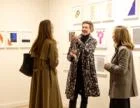
The ADAA Fair is back at the Park Avenue Armory through 16 November, a year after the Art Dealers Association of America cancelled its 2025 edition less than four months before opening. The organization called the cancellation a "strategic pause" to rethink how it serves members. The fair now runs under a new name, ADAA Fair, and in a noticeably different shape. My read is that it's a deliberately smaller fair, betting that fewer booths will matter more than a bigger footprint.
Fewer galleries, more room to move
Sixty-three galleries are exhibiting, about 12 fewer than the last edition. The cut responds to what dealers and collectors have been calling "fairtigue," a fatigue born of both the number of fairs and their size. Art Basel Miami Beach, the largest art fair in the Western Hemisphere, is also scaling back its participating galleries this year, so the ADAA isn't alone in pulling back.
The smaller roster frees up space around the circular bar at the center of the three-aisle expo. On opening night, that's where people gathered, drawn by the Whitney Museum of American Art's gala on Thursday, 12 November, which drew a strong turnout despite stormy weather in the city.
Kinsey Robb, who joined in 2024 and is the first person to lead the fair alone, frames the change as continuity. "It's a continuation. It's an evolution," she says. "It is still a small-scale collegial fair of the members, so that hasn't changed either. It's just adapting into the environment and the time that we're in." The hiatus, she adds, "gave us an opportunity to look at the oversaturation of fairs that were happening at that time, and the fatigue that people were feeling. This scale feels nice to me."
A younger crowd, and a market tilted toward the past
The partnership with the Whitney has brought in a new, often younger audience, according to participating dealers. The works on view, though, lean heavily toward Modern and post-war material on the secondary market, more than contemporary art. During the hiatus, the fair's longtime preview-night partner and beneficiary, Henry Street Settlement, teamed up with the Independent fair instead.
Robb's view of the fair's role is broad. "I think deeply about the ecosystem of the art world, and how we all are connected," she says. "Even if we all are in our own lanes or bubbles, we are all essential to each other in service of the art and in service of the artist."
Veterans and first-timers under one roof
The exhibitor list spans founding members and newcomers. Hirschl & Adler and Kraushaar Galleries were both founding ADAA members and took part in the Art Show's inaugural edition in 1989. First-time exhibitors include Alexander Berggruen, Sargent's Daughters, Piero Atchugarry, Nicodim and Hollis Taggart.
Taggart has run his namesake gallery for nearly 50 years but only recently joined the ADAA, which made this his first time applying and participating. He saw a different crowd on opening night than he gets in Chelsea, where his gallery is based, with many visitors coming from the surrounding Upper East Side. His stand is a dual presentation of two Abstract Expressionist painters, Michael (Corinne) West and Teruko Yokoi. On the market, he's measured. "I think it's very mixed, it's a bifurcated market," he says. "There's so many daily events that happen politically and financially, like the meltdown with Nvidia. I think the market's OK, but when you consider world events, it's a miracle that it's still as good as it is."
Early sales: priced high, selling across the range
The priciest works reported so far are Agnes Pelton's The Well of Peace (1932), with an asking price of $2.4m, and Beauford Delaney's Untitled (Paris) (1986), priced at $1.6m. Both came from the stand of New York dealer Jonathan Boos.
Elsewhere, the sales pattern runs wider. Kraushaar Galleries reported two paintings sold for six-figure sums, along with several works priced below $2,000. James Barron Art sold works by Beverly Pepper, Kenneth Noland and Kikuo Saito, each priced between $40,000 and $85,000. Yoshii Gallery sold several works ranging from $6,000 to $80,000. Chelsea-based gallery and advisory firm AH Arts sold a work on paper by Helen Frankenthaler for $75,000. Perrotin sold two Susumu Kamijo paintings priced between $30,000 and $45,000. San Francisco's Jessica Silverman reported eight sales from its presentation of new works by Julie Buffalohead, priced from $22,000 to $50,000.
Tribeca dealer Charles Moffett, who also showed in 2024, sold four paintings by Lily Stockman at $20,000 each and three paintings by Julia Jo at $30,000 each during the opening gala. Moffett welcomed the year off and the fair's approach to its members. "With so many of the fairs, once you're on the hamster wheel, it's like, go go go. You apply every year, and if you don't apply or if you decide to sit out a year, you go to the back of the line," he says. "I'm just grateful that this feels more like an organisation that wants to see the best for each gallery."
The test ahead
The fair has made its case on paper: fewer booths, more space, a crowd that differs from the Chelsea openings, and sales across a wide price band. The harder question is whether that discipline holds once the next application cycle arrives and the pressure to grow returns. If it does, the ADAA could offer a working model for how other fairs trim their calendars and their floor plans.

Discussion
Sign in to join the discussion.