A Gensler-designed renovation will add eight galleries, permanent collection displays and public spaces to ICA Miami’s expanding Design District campus.
A permanent home for the collection
ICA Miami’s planned expansion will give the museum something it has lacked since opening in the Design District: dedicated galleries for its permanent collection. The museum has appointed Gensler to renovate a 30,000-square-foot building nearby, doubling its exhibition and public-programming space. That change gives the institution room to show more of what it owns while continuing to stage temporary exhibitions and events across both locations.
The project will turn ICA Miami into a two-site campus and add the first permanent display of its collection, which now exceeds 2,000 works. The new wing is scheduled to open in late 2027, coinciding with the tenth anniversary of the museum’s current location. That timing gives the expansion a clear institutional marker, though the practical test will be how well the two buildings work together once visitors have to navigate between them.
Collection galleries and public programming
Eight galleries will fill the first and second floors, including spaces designed for the collection. The two buildings will share exhibition programming, while the new site gives the museum two full floors for collection displays. “Around every six months, we will refresh the collection display to reflect the collection’s emphasis and recent acquisitions,” director and chief curator Alex Gartenfeld tells The Art Newspaper.
A rotating presentation could make the permanent collection feel less like a fixed inventory and more like an ongoing curatorial argument. The works shown, and the relationships drawn between them, can change as the museum’s holdings grow or its priorities shift. For visitors, that means a return visit may offer a different view of the collection, even if the building itself stays familiar. It also puts pressure on the museum to explain why particular works are shown together and what each new arrangement reveals.
The third floor will host talks, symposia, lectures and performances. Gensler’s global culture and museums leader, Bevin Savage Yamazaki, says the renovation is intended to expand the museum’s support for artists and learning, and to create more room for exchange and belonging. Those aims will depend on more than the presence of an event space: programming, access and the way the public is welcomed will shape whether the floor feels like an active part of the museum or a venue used only on occasion.
That program builds on a structure already designed for art. “The building was developed to house a contemporary art collection,” Gartenfeld says. The renovation, he adds, will use its spaces to strengthen the museum’s story-driven approach to exhibitions and its collection. The building’s earlier purpose may give the museum a useful starting point, but adapting it still requires choices about circulation, display and how visitors move between different kinds of programming.
Opening the building to the neighborhood
The design will adapt the existing building, formerly home to the De la Cruz Collection, which closed after co-founder Rosa de la Cruz died in 2024. ICA Miami acquired the property for $25 million later that year. Since then, it has mainly hosted educational programs; it will close when construction starts. The shift from an educational-programming site to a dedicated exhibition and public-programming wing marks a change in how the museum intends to use the property.
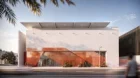
A redesigned façade with transparent elements is meant to connect the museum more visibly with activity on the street. Plans also call for a redesigned lobby and reconfigured outdoor areas with social spaces, a sculpture deck and an expanded café. “We are aiming to create a more collective experience,” Gartenfeld says. The design points toward a museum that wants its public spaces to be part of the visit, rather than treating the galleries as the only reason to enter.
That ambition has a practical dimension. A visible entrance and outdoor gathering areas can make an institution easier to approach, while a café and social spaces may give people reasons to spend time on the site beyond seeing an exhibition. But architecture can only set the conditions. The museum’s programming and daily operations will determine whether those spaces feel genuinely open and useful to the neighborhood.
What the expansion changes
Accessibility and the visitor experience are central to the changes. The expansion is part of a $40 million capital campaign funded entirely by private contributions. The scale of the campaign signals a substantial commitment to the project, while the plan itself gives ICA Miami a way to display its collection more consistently and broaden its public programming. Those are related goals, but they’ll require careful coordination across two buildings.
This is more significant than it looks. A permanent collection display can give a museum a clearer account of its own holdings and make those works part of the institution’s regular public identity. At the same time, a second site adds a new question for visitors: how do the two buildings fit into one experience? If you’re working in this space, that’s the operational challenge to watch, alongside the curatorial one. (And this is the part most people overlook.)
ICA Miami’s next chapter will depend on whether the new galleries, events and street-facing spaces support one another in practice. The building will give the museum more room; the choices about what to show, how often to change it and how to invite people in will give that room meaning. A larger footprint, by itself, doesn’t guarantee a stronger connection with visitors. The work of making the two-site campus feel like one institution starts with the opening—and continues after it.



Discussion
Sign in to join the discussion.