Frieze LA returns in February 2027 with 102 exhibitors, a strong local contingent and four debut galleries as its venue faces a 2028 closure.
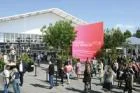
Frieze Los Angeles is keeping its exhibitor count steady while galleries continue to cycle through the fair. Its eighth edition, set for February 2027 at Santa Monica Airport, will feature 102 participants, with year-over-year turnover at about 28% for the second consecutive year. The headline is stability; the roster beneath it tells a more fluid story. A consistent total can conceal real shifts in which galleries see value in the event, which can afford to take part, and which are redirecting their attention elsewhere.
A deep Los Angeles contingent
More than one-third of exhibitors operate in Los Angeles, including Jeffrey Deitch, Regen Projects, David Kordansky, Château Shatto, Commonwealth and Council, Anat Ebgi, Night Gallery, the Pit and Roberts Projects. That local concentration gives the fair a strong regional base, while also making its exhibitor list a useful snapshot of the city’s gallery community. For visitors, it means the fair won’t be limited to an imported view of the art market: many participating galleries are presenting work from within the city where the event takes place.
Four Los Angeles galleries will make their Frieze debuts in the Focus section for emerging spaces: Megan Mulrooney, Rajiv Menon Contemporary, House of Seiko and Zodiac Pictures. Erin Christovale of the Hammer Museum will curate the section. The debut placements give the four galleries visibility within a fair better known for established international names, though participation alone can’t establish how much lasting attention or business they’ll receive. The curatorial role matters, too: Focus offers a distinct frame for emerging galleries, rather than treating them as a smaller version of the main exhibitor roster.
Major international names returning include Gagosian, Hauser & Wirth, David Zwirner, Pace, White Cube, Perrotin, Gladstone, Almine Rech, Thaddaeus Ropac and Sprüth Magers. Their presence supplies continuity and familiar reference points for collectors who follow the fair across editions. Newcomers include San Francisco’s Gallery Wendi Norris, New York’s Franklin Parrasch, Seoul’s G Gallery, Antwerp’s Newchild, and Brazil’s Yehudi Hollander-Pappi and Danielian. The mix broadens the roster’s geographic reach, though a list of participating cities can’t by itself show how deeply each gallery is investing in Los Angeles or what audiences will encounter in its booth.
Turnover against a changing market
Several galleries from recent editions are absent, among them Berggruen Gallery, Ortuzar, Tina Kim Gallery, Mendes Wood DM, Nara Roesler, Southern Guild and Timothy Taylor. The changes come after a pandemic-era rush of galleries establishing Los Angeles outposts gave way to closures, amid a global art-market downturn and the effects of the 2025 wildfires. The Landing on Jefferson Boulevard was among the recent local closures; Southern Guild and Pietro Alexander have shifted their focus to New York. These developments put the fair’s stable exhibitor count in perspective: the total can hold even as individual galleries leave, arrive or change their plans.
About 28% turnover for a second year running is substantial enough to make roster continuity a limited measure of the fair’s health. It shows that the event can refill places as galleries depart, but it doesn’t reveal whether the new participants are replacing the commercial weight, audience reach or local ties of those that are gone. That distinction matters in a market downturn, when galleries may be more selective about the fairs they attend and the costs they take on. The numbers here are underwhelming as a story of change: the percentage signals movement, but the source doesn’t say what drove each gallery’s decision.
At the entrance, visitors will encounter Queercancha, a new work by Los Angeles artist rafa esparza. Painted across two adobe panels mounted on chrome steel, it draws on Southern California’s lowrider cruising culture. The placement gives the fair a local point of entry before visitors reach the gallery booths, connecting the event to a cultural reference grounded in the region. A single commissioned work can’t stand in for the city’s wider artistic life, but it can shape the terms on which visitors begin to read the fair.
A venue with a deadline
The airport site may have only a few editions left as Frieze’s home. Santa Monica Airport is scheduled to close permanently to aviation at the end of 2028 and become a public park. That gives the 2027 fair a distinct setting: a large local presence and a stable exhibitor total, hosted at a venue whose future is already mapped out. The airport’s planned change also puts a practical limit on how long the fair can rely on this location, even as its next edition remains on the calendar there.
What the roster signals
This is more significant than it looks: Frieze Los Angeles is maintaining its scale while the galleries around it are reassessing where to operate and where to show. If you’re working in this space, the useful question isn’t simply whether the fair has 102 participants; it’s whether its combination of local galleries, established international exhibitors and new entrants can keep drawing visitors as the surrounding market shifts. The roster points to a continuing appetite for the event, but turnover and venue uncertainty make that appetite harder to read as settled confidence.
And yet, the airport’s scheduled closure gives the 2027 edition a clear horizon. The fair will take place in a setting already slated for a different public use, while its exhibitor list continues to change. (And this is the part most people overlook.) A stable count is an outcome, not an explanation. For now, the fair’s position rests on its ability to bring a changing group of galleries together in Los Angeles, with the next venue question waiting beyond the edition at hand.
Discussion
Sign in to join the discussion.