Hiding Places trade the noise of their debut for a patient, harmony-driven single that asks what paradise means once things change.
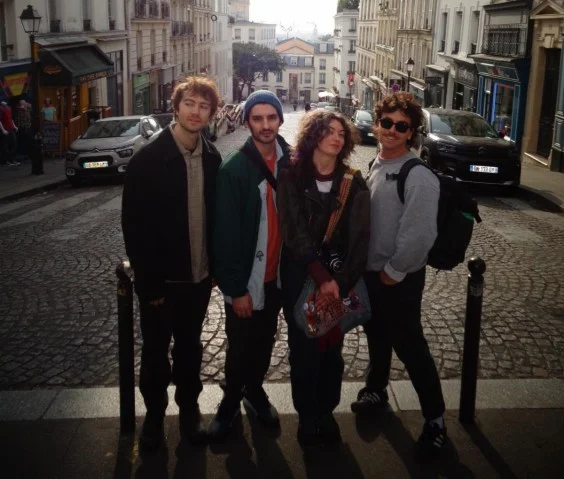
Hiding Places don't usually sit still. Their debut, The Secret To Good Living, runs on blown-out guitars and Audrey Keelin's meditative vocals, with Nicholas Byrne's bleary twang cutting in at the edges. The new single "Paradise" dials most of that down. It's the gentlest thing the Queens band has put out, and it might be the most revealing.
That's a risky move for a group whose sound was built on contrast. A follow-up that pulls back can read as confidence or as uncertainty, and the difference usually shows up in the details rather than the press release. In this case, the details point toward confidence. The band isn't hiding behind softness; it's making softness the point.
A slow burn, on purpose
Here's the thing: a song this quiet is a deliberate choice. Michael Matsakis explains the approach: "A goal with the arrangement was to hold back in order to not let the song get too heavy too fast. I felt like a slow burn matched the energy of the song more than something that gets super big." The band stripped the instrument parts down to basic melodic fragments, then wove non-melodic lines together to build the harmonies. The result sounds spare, but every line has a job.
Most bands reach for layers when a track starts to feel thin, and it's a common reflex. Adding a second guitar or a bigger drum fill is the easy fix. Pulling back is harder, because every missing part gets noticed, and a weak idea has nowhere to hide. Matsakis's comments suggest the band understood that risk from the start.
And yet the restraint here isn't empty. Reducing the instruments to melodic fragments forces each remaining line to carry weight, while the non-melodic lines quietly fill out the harmonies underneath. (and this is the part most people overlook) Your ear does a lot of the filling in when the arrangement leaves room, which is why sparse songs can feel fuller than dense ones. The band is betting that you'll lean in.
Three readings of one song
Keelin's starting point came from a bandmate named Michael, who told her that "Paradise isn't what it used to be." She hears the song as a study in perception. A face isn't the same every time you look at it, time moves on, and change is constant. The song, she says, tracks the moment the narrator makes that realization personal, which is a far more uncomfortable place to stand than an abstract observation about getting older.
Byrne approaches it from the other side. Is paradise a place where every desire comes true, or is it a projection of your fears, where each desire doubles as its own cure? For him, the answer is quieter: "Making peace with change, that feels how I thought paradise would." That's a more hopeful reading than the song's melancholy first impression suggests. It's also the tension that keeps the track interesting on repeat.
I'd argue the song works precisely because it won't settle on one reading. Keelin's version is about loss and Byrne's is about acceptance, and both fit the same lyrics without strain. If you've ever played a sad song and walked away feeling lighter, you'll recognize what's happening here. Ambiguity is harder to write than certainty, and it's easy to mistake for vagueness. This track avoids that trap.
Video and tour
The "Paradise" video was directed by Hiding Places and Nara Avakina. It's worth watching with the lyrics in mind, since the visuals lean into the same question of what stays and what shifts. Band-directed videos can go either way: they sometimes feel like an extension of the record, and sometimes like a costume change. Here, the intent seems to be the former, which fits a single that asks listeners to pay attention rather than react.
The band heads out on a run that starts in December with dates in Medford, Montreal, Toronto, Detroit, Nashville, Louisville, Pittsburgh, Washington, Philadelphia, and New York's Bowery Ballroom. Dates continue into the new year, including Brooklyn's Baby's All Right on January 23, before a spring leg through Philadelphia, Washington, Durham, Atlanta, Chicago, Wisconsin, Minnesota, and Ohio. Wild Pink, Horsepower, and Hudson Freeman appear as support on different stops. A tour that long gives a quieter song room to breathe, or to get lost, depending on the crowd and the venue.
That's the real test for a record like this. A hushed track can land beautifully in a small room with attentive listeners and fall flat in a loud club where the bar is the main event. If you're planning to catch a show, the venue size will probably shape your experience more than the setlist will. Dense songs survive bad rooms; delicate ones need good ones.
What this single signals
"Paradise" suggests the band is more interested in patience than volume now. If the debut built its power from noise, this single shows what happens when Hiding Places let the room go quiet, and that's a direction worth watching on the road. It doesn't prove the band can sustain that restraint across a full album, and a single is a small sample. Still, the choice to lead with the gentlest track it has released says something about where its confidence sits.
There's a reasonable question about whether the quiet approach holds up over time. Bands that lean on dynamics often struggle to keep listeners engaged once the novelty of restraint wears off. My read is that Hiding Places has the songwriting to avoid that, since the ambiguity in "Paradise" rewards repeat listens rather than demanding them. Whether the rest of the material follows suit is the open question, and it's the one I'd keep an eye on.



Discussion
Sign in to join the discussion.