In paintings shaped by Guadeloupean folklore and Tamil ancestry, Kelly Sinnapah Mary blends family memory with vivid, human forms of nature.
Kinship in a Surreal Garden
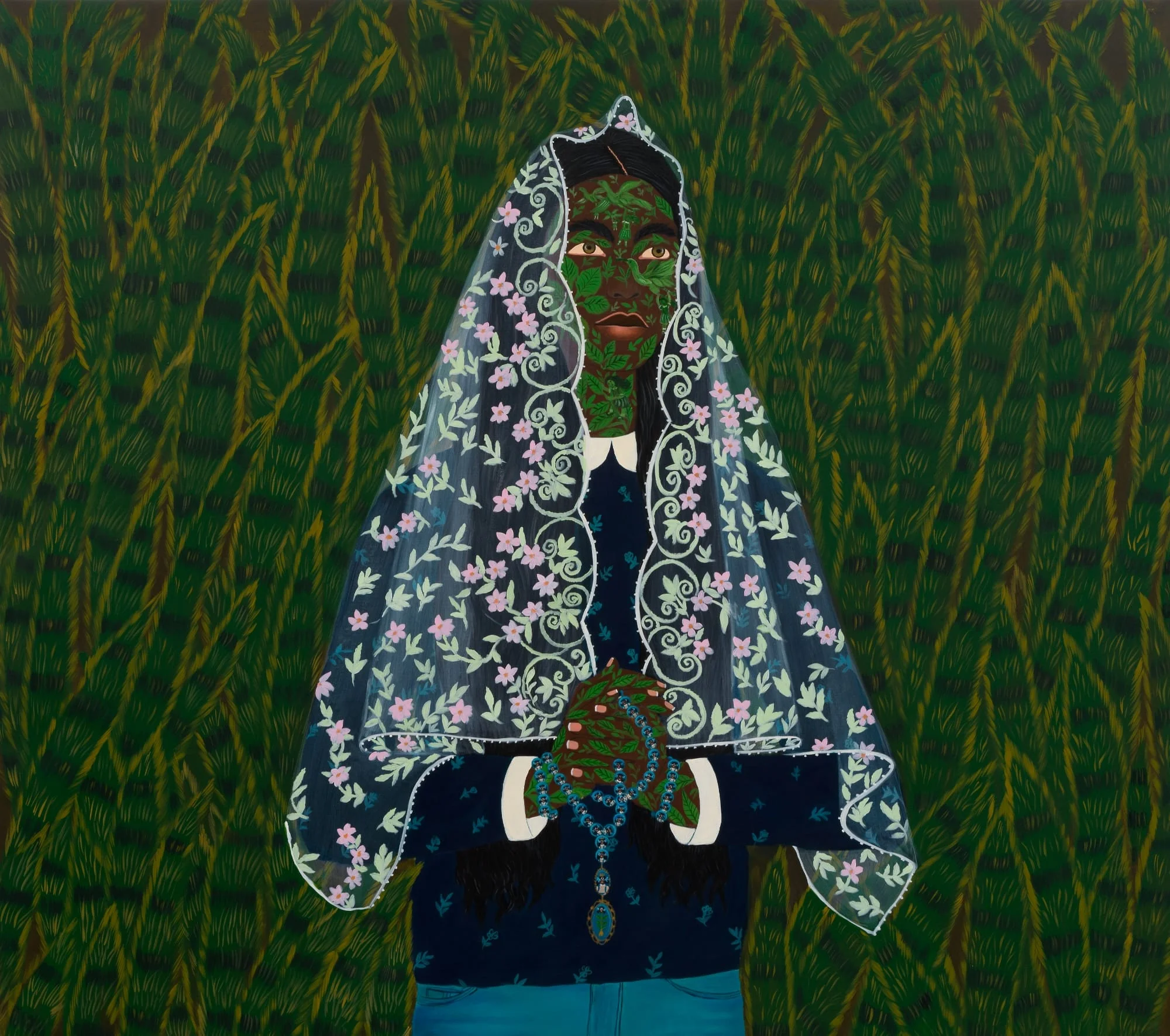
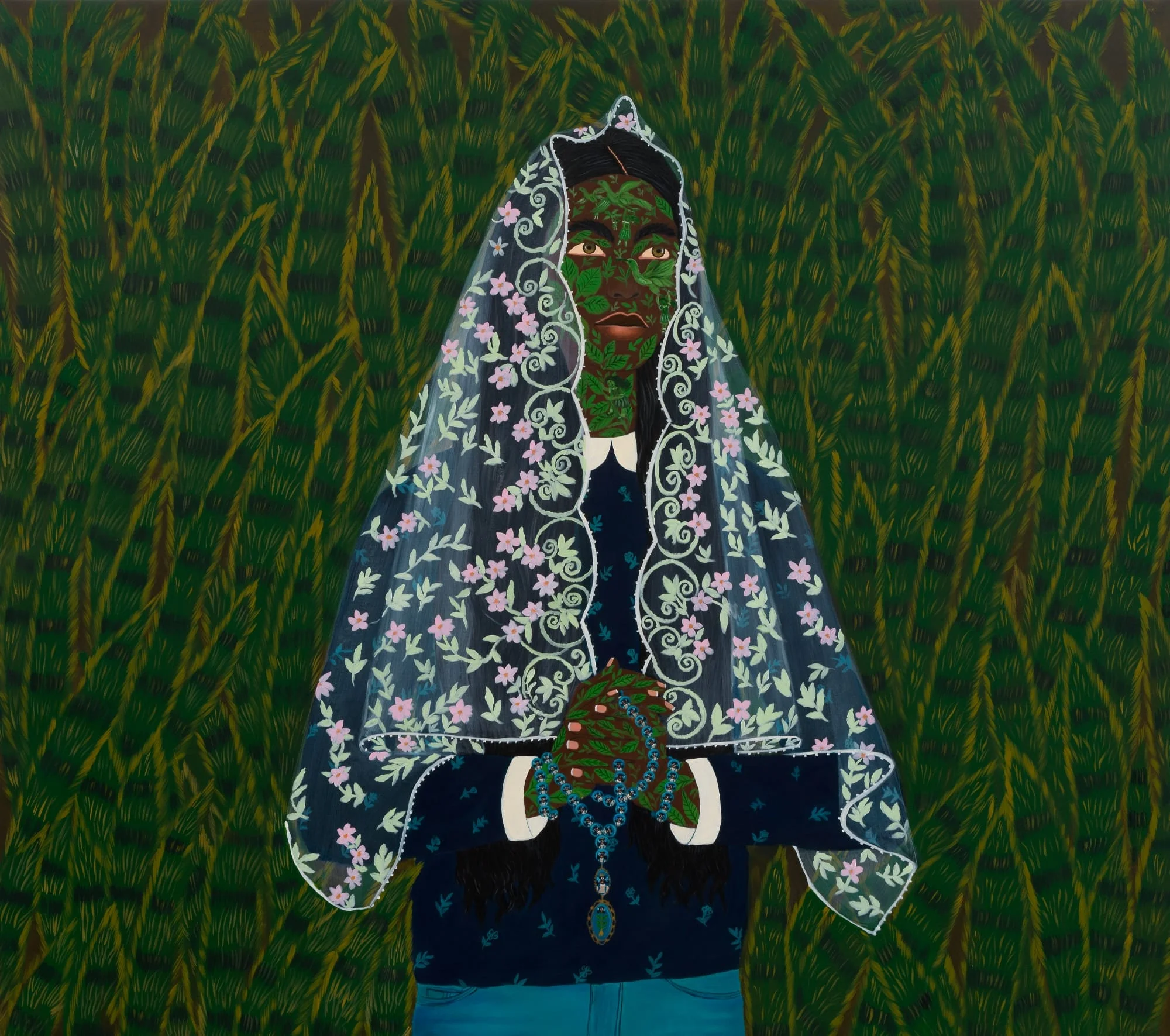
Kelly Sinnapah Mary’s paintings make kinship visible: figures merge with leaves, flowers bear human faces, and myth sits alongside the details of family life. Born in Guadeloupe, the artist draws on Caribbean folklore to imagine a world where people, plants, and animals share an unsettled, intertwined existence. The images invite close looking, but they resist the idea that nature is merely a backdrop for human stories. The lush surfaces are beautiful, and their underlying questions are pointed: how do histories of colonialism and human dominion shape our ties to other living things?
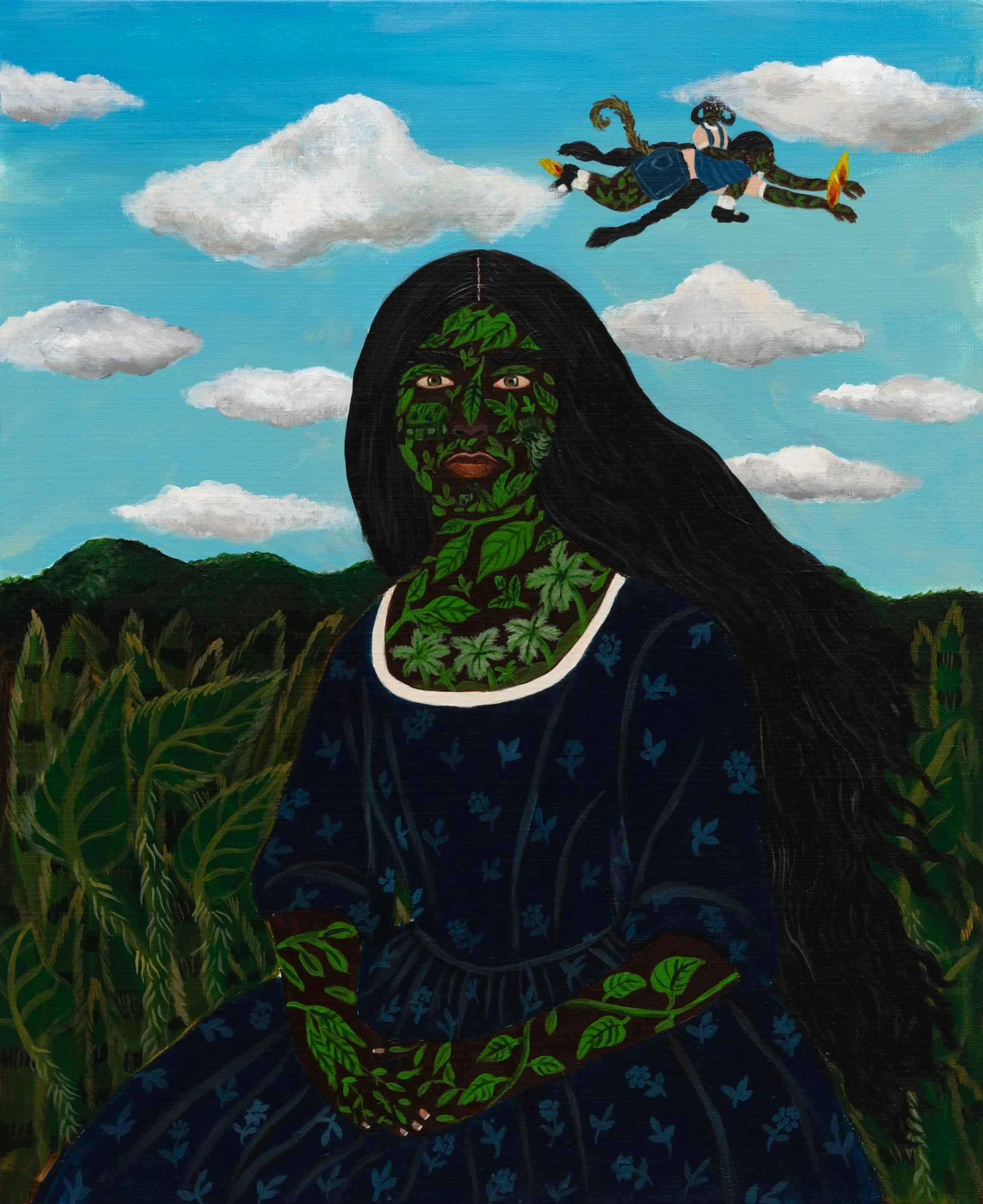
That tension runs through Sanbras, a recurring figure whose name Sinnapah Mary took from a derogatory children’s book once popular in the 19th and 20th centuries. Rather than fix the character in a single identity, the artist lets Sanbras shift across bodies of work. This refusal of a stable image matters: the figure can carry the weight of a stereotype while changing its meaning through each appearance. Saturated color and finely rendered organic forms give these scenes their pull, while Sanbras’s changing presence challenges the assumptions embedded in the name.
Family Stories and Inherited Identity
Family history gives this vision another dimension. Sinnapah Mary grew up identifying as Afro-Caribbean, then learned that her ancestors included indentured workers from Tamil Nadu, in southern India. They were brought to the Caribbean after slavery was abolished to replace enslaved labor, adding another strand to her understanding of identity and place. That discovery complicates any simple account of belonging: family memory can connect a person to histories that weren’t part of the identity they first understood themselves to have.
Here’s the thing: the paintings don’t present this inheritance as a tidy origin story. They hold multiple cultural references and family accounts together, leaving space for uncertainty and reinterpretation. If you’re working in this space, that choice matters; an image can acknowledge historical violence without reducing a person’s identity to that violence. The work’s hybrids make that tension visible in bodies that refuse a clean separation between human and plant, past and present.
Violette’s Garden as Archive
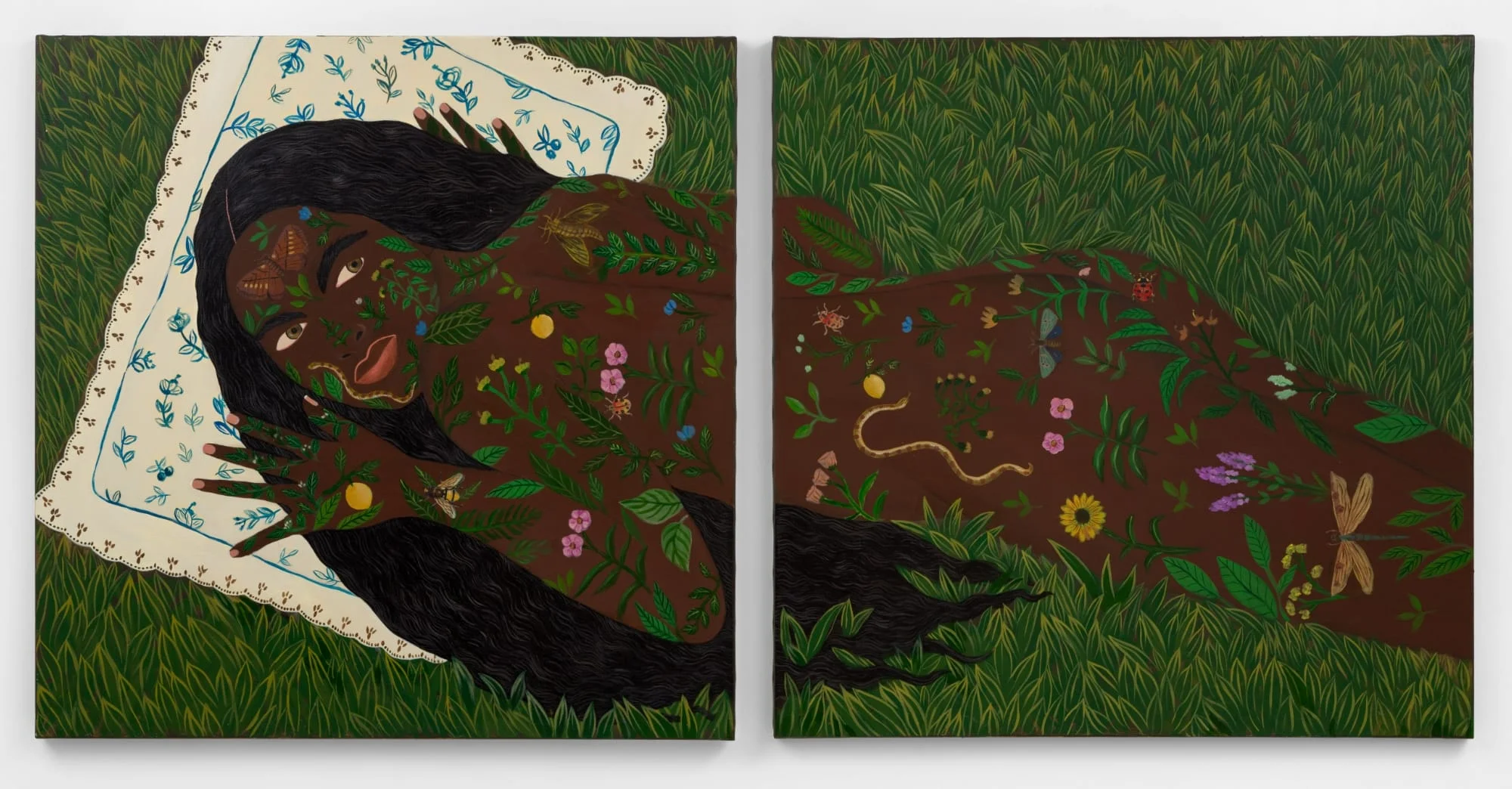
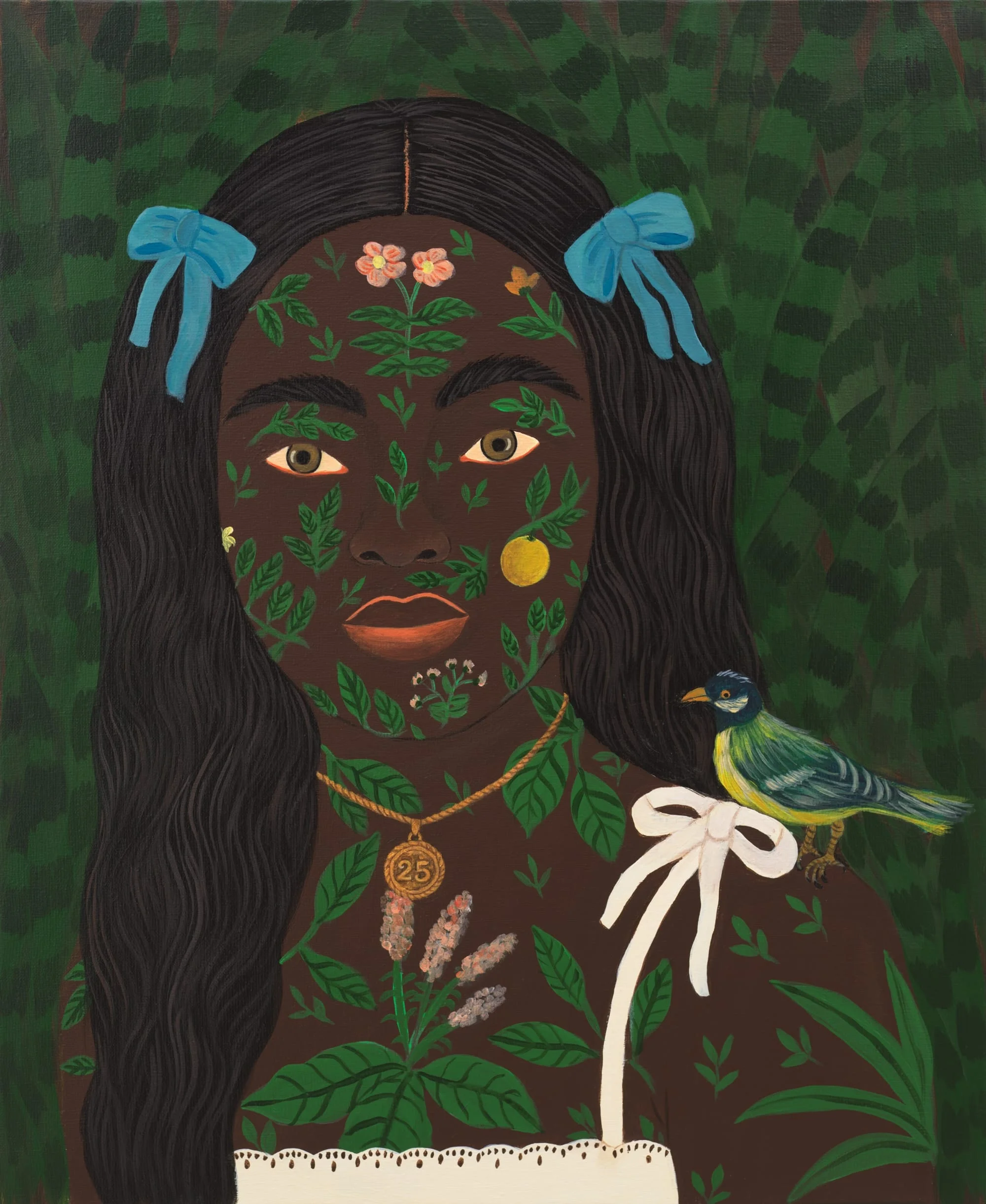
In The Book of Violette, named for the artist’s grandmother, that history becomes intimate. The series turns to folklore and the ways memories travel between generations, often through solitary figures. Its imagery draws on Violette’s garden of medicinal plants, a source of family knowledge that Sinnapah Mary has described as magical. A garden here can be read as more than a setting: it’s a place where practical knowledge, care, and stories are passed along, even when those forms of knowledge sit outside formal records.
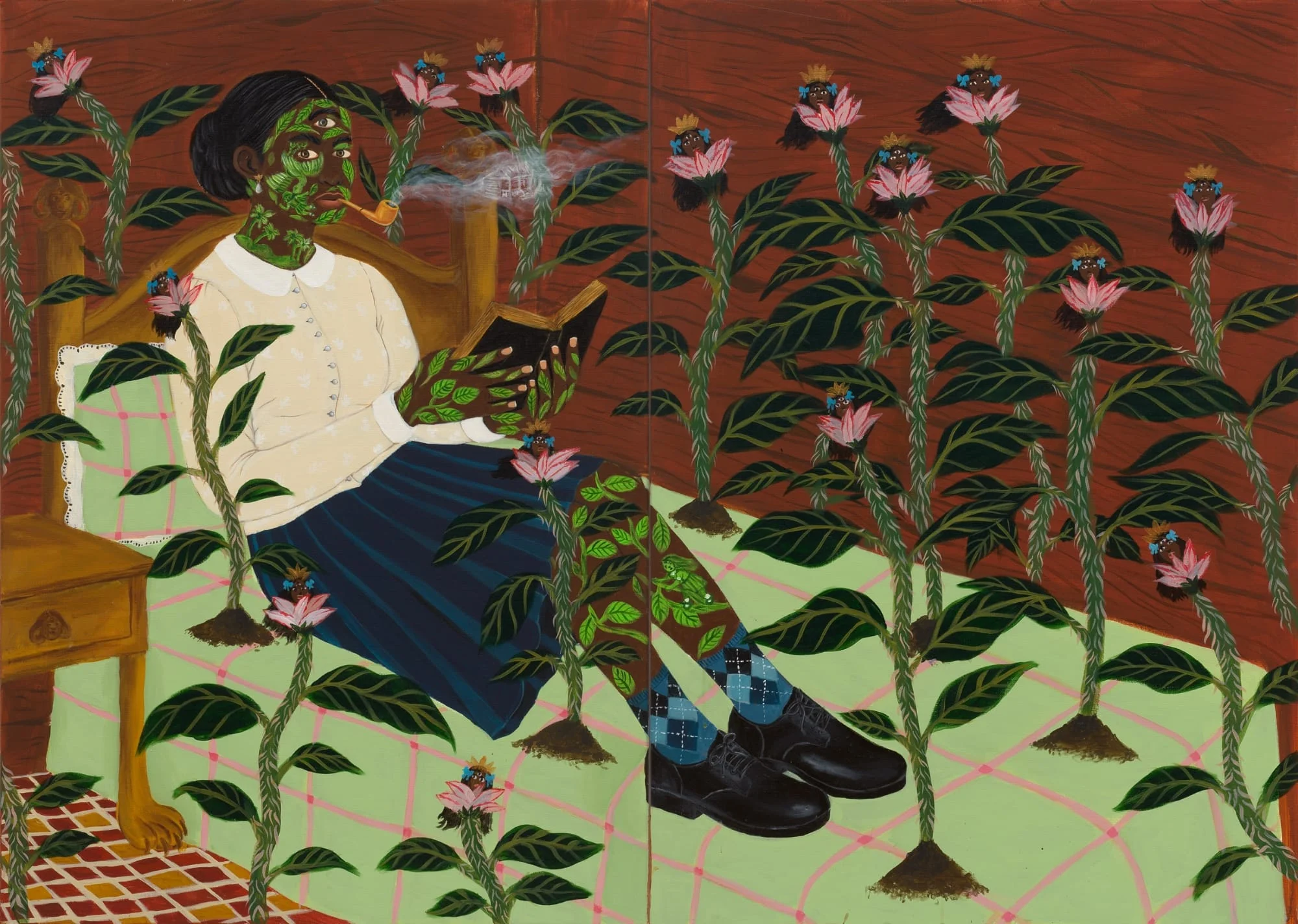
In “Violette’s Garden: My Father’s Shoes,” flowers with human heads rise from a plaid coverlet. A schoolgirl holds a gilded book and smokes a pipe, meeting the viewer’s gaze with a third eye—an image associated with wisdom and spiritual connection in Hinduism. The domestic bed and the uncanny garden share the same space, so the scene doesn’t ask viewers to choose between ordinary life and myth. Instead, it lets inherited memory move through both. “When I paint, I am channeling both my family mythology—the stories that have been told to me, the memories I have—and broader histories and cosmologies to imagine a new world,” Sinnapah Mary says.
The image is dense, but its references don’t resolve into a single key. That’s a strength. The work brings these cultural and familial elements together without flattening them into one explanation, and the viewer has to sit with the connections rather than decode a fixed message.
Scale, Relationships, and What Comes Next
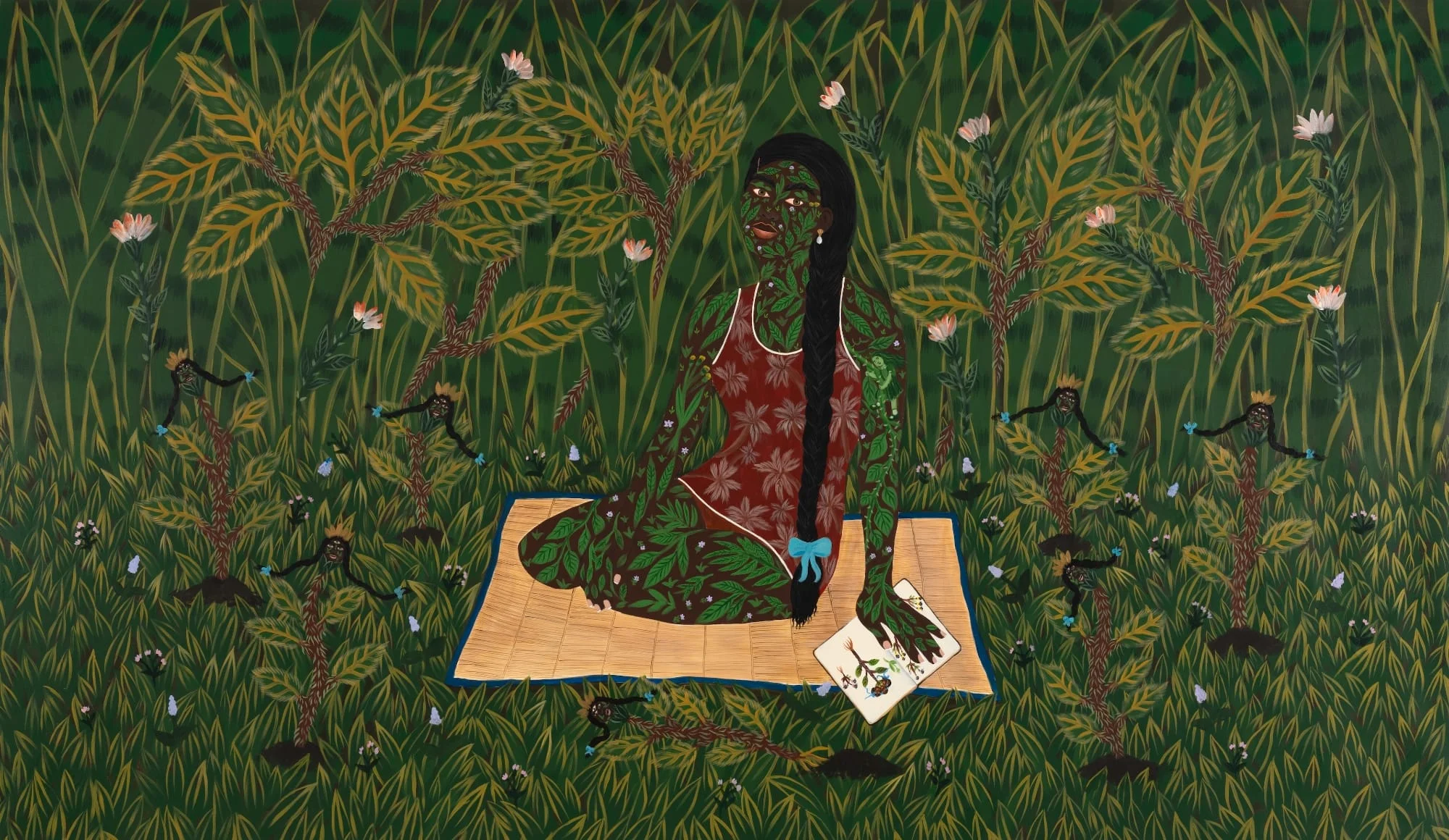
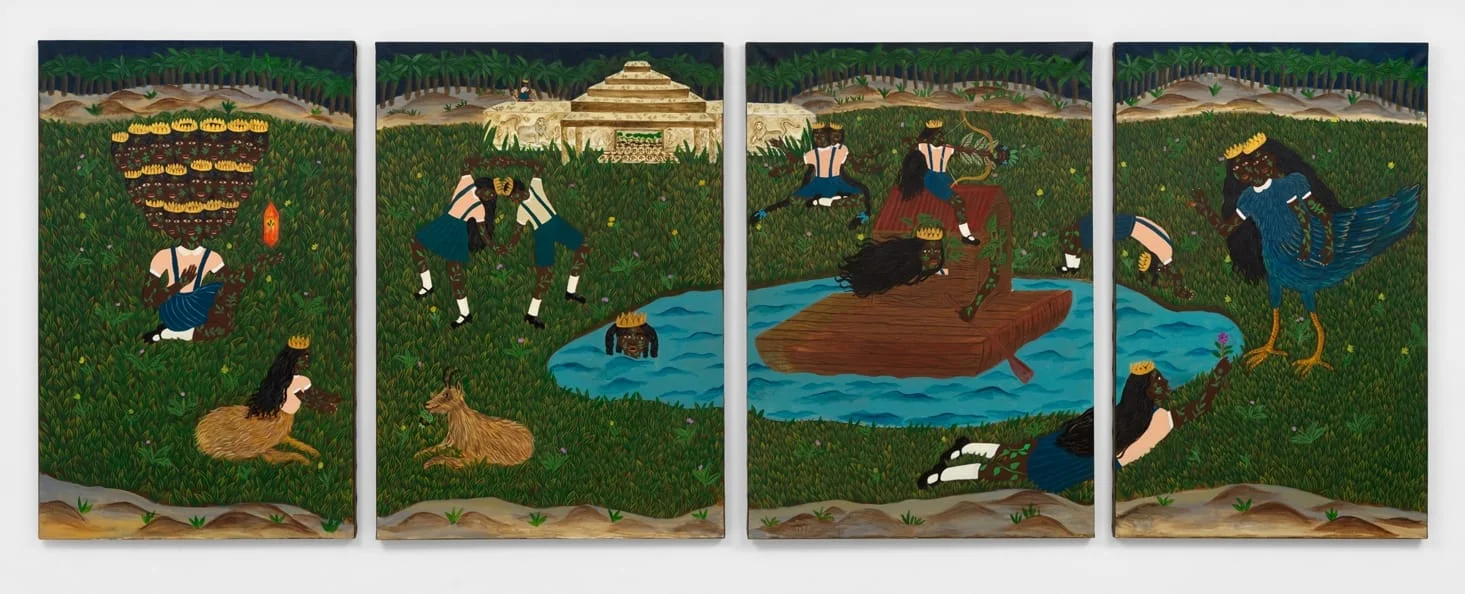
The series ranges from close portraits to expansive scenes populated by hybrid beings. Its scale shifts, but the central idea holds: identity is shaped by inherited stories and relationships that exceed the human. In a small portrait, foliage can appear directly across a person’s skin; in a broad scene, human-animal figures inhabit a shared terrain. The scale changes the viewer’s point of entry, while the entanglement remains. This is more significant than it looks: the paintings don’t treat human identity as self-contained.
And yet, the imagery’s beauty can make its harder questions easy to miss. The works suggest that relationships with plants and animals are also shaped by histories of power, and that inherited knowledge may survive through intimate acts of care. They don’t offer a program or a neat resolution. Their insistence is quieter: look again at what counts as family, history, and the living world.
Sinnapah Mary’s exhibition Between earth and sea is scheduled to open in February at The Aldrich Contemporary Art Museum in Ridgefield, Connecticut. The title places the show between two environments that recur in Caribbean histories and imaginaries, though the source gives no further details about its installation. For visitors, the paintings offer a way into the artist’s layered approach to memory: through bodies, gardens, and stories that keep changing as they’re handed down. A world held in relation.

Discussion
Sign in to join the discussion.