Dave Longstreth’s new Dirty Projectors single pairs piano and vocals with Chris Bear, Karl McComas-Reichl and a six-piece horn section.
Dirty Projectors’ “Jumbotron” points toward a more restrained sound for Dave Longstreth’s project: piano-led, jazz-tinged and shaped by a full ensemble. The single is out now on Well-Tempered Zealot, the new imprint Longstreth launched with Joyful Noise. Its arrangement makes the song feel less like a showcase for the group’s familiar stylistic turns and more like a study in pacing: how much a singer can leave unsaid, and how much an ensemble can contribute without pushing the song into grand gestures.
A solo project with an ensemble behind it
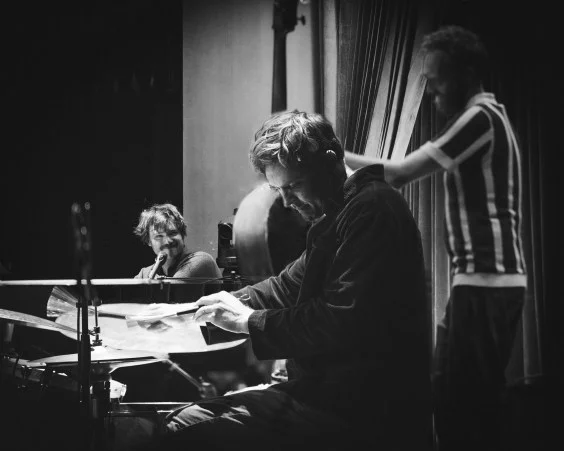
Longstreth sings and plays piano on the track, joined by Grizzly Bear drummer Chris Bear, upright bassist Karl McComas-Reichl of the Jeff Parker Trio, and six Los Angeles session musicians on horns. That’s a substantial group for a song whose defining quality is restraint. The piano gives the arrangement a clear center, while the bass, drums and horns let it move around that center rather than driving it toward a loud climax.
The arrangement gives the song a wandering, unhurried feel, with Longstreth in a sedate crooner mode. That vocal approach shifts the listener’s attention from virtuosity to tone and phrasing. A singer working at lower intensity has less room to rely on sheer force; the pauses, small changes in emphasis and fit between voice and accompaniment carry more of the weight. The result sounds composed around space as much as around sound.
There’s also a useful tension in the credits. Longstreth is presenting Dirty Projectors as a solo project, yet “Jumbotron” depends on several collaborators, including a horn section. The label describes who played, but it doesn’t tell us how the arrangement came together or how much the musicians shaped the finished track. Still, the contrast is audible in the basic setup: a project led by one songwriter, expressed through a collective performance.
That combination isn’t unusual in music, but it does complicate what “solo project” means here. It can describe who leads the work without suggesting that every recording will be made alone. For listeners, the distinction matters because a tour built around one performer may offer a different experience from a recording that draws on a full ensemble. The song gives a clear sense of the recorded texture, but it can’t settle what the live version will sound like.
That sound raises a question about what comes next. Longstreth is currently presenting Dirty Projectors as a solo project and plans to tour alone next year, but “Jumbotron” is built around collaborators. Whether this approach carries into a future record remains unclear; for now, the single offers a quieter take on his songwriting. It’s a suggestive first point of reference, not a reliable map of the project’s next phase.
Longstreth framed the song around contrasts in how people watch and listen: “I was thinking about the big screen and the small screen. The big tent and the kind of tent you can make in the living room with a couple couch cushions and a blanket or two. Life and entertainment; attention and volume; focus and detail; quality and value. Listen to the song!” The image pairs public spectacle with private attention, and the song’s measured arrangement fits that framing. Rather than treating scale as a matter of sheer loudness, it asks what changes when a listener gets close enough to notice the details.
That idea gives “Jumbotron” a conceptual frame, though the quote doesn’t explain every musical decision. The song’s title points toward spectacle; the performance, as described, leans toward intimacy. This is more significant than it looks: the contrast lets the track make a point through its form, without needing to turn into a manifesto about screens or entertainment. And yet, a single can only suggest how far that idea might travel across a larger body of work.
What the shift could mean
For Longstreth, the move toward piano, horns and a slower vocal delivery opens up a different set of choices. A denser ensemble can create color and movement, but it also requires decisions about when to hold back. Here’s the thing: the presence of more musicians doesn’t automatically make a song feel bigger. If the arrangement is allowed to breathe, the added players can make small changes in texture more noticeable.
That’s where the song’s restraint may matter most. Listeners familiar with Dirty Projectors may hear a change in emphasis, but the available information doesn’t establish that this single represents a permanent turn. It could be an isolated approach, a preview of more material in this style, or simply one way Longstreth wants this particular song to sound. The evidence supports curiosity, not certainty.
If you're working in this space, the practical question is how a song built around a larger cast translates when its songwriter tours alone. A solo performance can make the writing and its structure more exposed; it may also call attention to parts of the arrangement that the studio version distributes across several players. We don’t yet know how Longstreth will handle that shift onstage. For now, the tour offers a chance to hear the solo presentation alongside a recording whose character comes from collaboration.
One possible takeaway, then: the project’s label may describe its leadership more clearly than its sound. The single is solo-led, ensemble-shaped, and deliberately measured. A quieter register. Whether that combination becomes a lasting direction is still an open question.
Dave Longstreth tour dates
Longstreth’s solo dates include U.S. and European shows. Otto Benson joins him at the dates marked with an asterisk. The schedule moves from festival and venue appearances in the United States to a run of European performances. That spread gives listeners on both sides of the Atlantic a chance to hear the solo format, though the listings alone don’t indicate what arrangements or instrumentation each show will use.
The asterisks identify the dates with Benson, while the other shows are listed without that designation. The range of rooms and locations suggests a tour designed around individual performances rather than one continuous festival appearance. If you're planning to attend, check the venue’s current details for practical information about each show.
04/02 — Knoxville, TN @ Big Ears Festival
04/15 — Minneapolis, MN @ Cedar Cultural Center *
04/17 — Chicago, IL @ Old Town School of Folk Music *
04/20 — Philadelphia, PA @ Ethical Society *
04/21 — New Haven, CT @ Firehouse 12
04/23 — Boston, MA @ Museum of Fine Arts *
04/24 — Kingston, NY @ Assembly *
04/25 — New York, NY @ Le Poisson Rouge *
05/08 — Los Angeles, CA @ Sid the Cat Auditorium
05/14 — San Francisco, CA @ The Chapel
05/15 — Point Reyes, CA @ Dance Palace
05/20 — Portland, OR @ Polaris Hall
05/21 — Seattle, WA @ The Triple Door
06/11 — Manchester, UK @ Band On The Wall
06/12 — Glasgow, UK @ Oran Mor
06/14 — London, UK @ Kings Place
06/15 — Paris, France @ Café de la Danse
06/17 — Utrecht, Netherlands @ TivoliVredenburg Hertz
06/18 — Brussels, Belgium @ Musée Botanique
06/19 — Hamburg, Germany @ Nachtasyl
06/20 — Copenhagen, Denmark @ The Koncerthuset - Studie 2
06/22 — Stockholm, Sweden @ Södra Teatern
06/23 — Oslo, Norway @ Kulturkirken Jakob
06/25 — Berlin, Germany @ Lido
“Jumbotron” is available now from Well-Tempered Zealot/Joyful Noise. As a first look at this version of Dirty Projectors, it offers a pointed contrast: a project presented as solo, with a recording whose character depends on a roomful of players. The next record, if and when it arrives, will show whether that tension is central to Longstreth’s plans or belongs to this song alone.



Discussion
Sign in to join the discussion.