PJ Harvey co-wrote and sings on Shida Shahabi’s “Wreath,” and contributes to Oliver Leith’s newly released Doom And The Dooms.
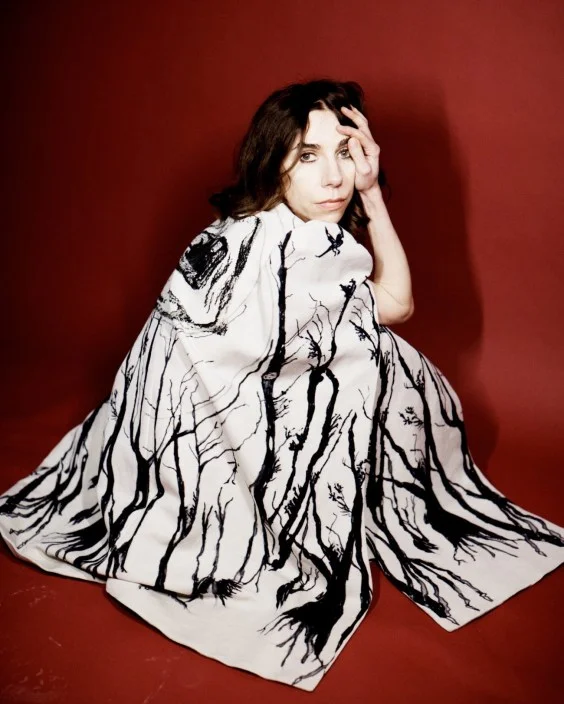
PJ Harvey’s recent collaborations put her voice inside two markedly different experimental projects. She co-wrote and sings on “Wreath,” a slow-building piece from composer Shida Shahabi’s forthcoming album, and makes multiple contributions to Oliver Leith’s Doom And The Dooms, released last month.
The pairing matters because Harvey isn’t simply lending a familiar voice to two records. In Shahabi’s work, the composition sets the terms for how the words and singing take shape. Leith’s album, meanwhile, connects to a memory Harvey says has stayed with her since childhood. Both projects place her within someone else’s musical frame, but they draw on different kinds of exchange: one formed in the studio, the other rooted in a long personal response to a piece of music.
A song shaped around Shahabi’s music
“Wreath” began with Shahabi recording overtones and building slow musical progressions. The six-and-a-half-minute drone track grew from that foundation, with Harvey and Shahabi shaping its words and vocals around the music’s gradual transformations. That order is telling: the singing follows the composition’s movement, rather than serving as a conventional lead layered over a finished backing track.
Harvey asked Shahabi to write freely in response to the piece. She then edited those words, added material and kept the melody simple and repetitive. The pair discussed giving the song a cyclical feeling, with life and death, beginnings and endings, reflected in its structure. At the close, Shahabi loops Harvey’s voice into the arrangement as an instrumental texture.
The repeated melody suits a track built from gradual change. In music like this, small shifts in sound can carry more weight than a dramatic turn or a dense sequence of lyrics. The voice becomes part of the arrangement as much as a vehicle for the words. And this is the part most people overlook: the closing vocal loop extends the song’s structure beyond the point where a conventional vocal performance might end.
“It felt like a living organism,” Harvey said of her first impression of the music. She described the collaboration as a chance to let Shahabi’s composition guide the words, and said she was proud to be part of the album. That description fits the process she outlined: the music prompted the writing, and the finished vocal returns to the sound world that prompted it.
Shahabi, an Iranian-born composer based in Stockholm, said she sensed early on that the piece was ready for another artist to enter. She first met Harvey in London two years ago. The two later met again when Harvey curated Gunnersbury Park Festival and invited Shahabi to perform; they have remained friends since. Their history gives the collaboration a personal foundation, though the account of “Wreath” suggests that the musical decision came down to the specific demands of the piece.
Another collaboration, a different kind of memory
Harvey also appears on Doom And The Dooms, the latest album from British musician Oliver Leith. Recorded with guitarist Sean Shibe, GBSR Duo and 12 Ensemble, the record is described as having been “recreated from tapes found at a garage sale.” Leith’s work includes Last Days, an opera inspired by Kurt Cobain. The album’s unusual description points to a different creative premise from Shahabi’s carefully built drone piece: a record reconstructed from discovered tapes, with Harvey entering a work that already carries the idea of recovered sound.
Harvey’s connection to the album is personal: she recalled hearing Doom And The Dooms on the radio as a child and being drawn to the music’s mix of melancholy and joy. She said that feeling has influenced her own work ever since. That memory helps explain why her contributions are meaningful beyond a guest appearance. The project reconnects her with an early listening experience that she says shaped her artistic instincts.
There’s a useful contrast here. “Wreath” is described through a direct working partnership, with its words and vocal arrangement taking shape in response to Shahabi’s music. Leith’s album reaches Harvey through an older association, one she has carried into her own work. If you’re working in this space, that distinction matters: collaboration can mean making something new together, but it can also mean returning to a piece of music that has already changed how you hear.
What the collaborations say about Harvey’s next chapter
Harvey’s most recent solo album, I Inside The Old Year Dying, arrived in 2023. These projects show her taking a collaborative route, contributing to composers’ records while her next solo release remains unannounced. That doesn’t tell us what her next album will sound like, or when it might appear. It does show a performer willing to let another artist’s structure shape the role she takes on.
This is more significant than it looks. On “Wreath,” Harvey’s voice becomes part of the composition’s texture; on Doom And The Dooms, her involvement is tied to a musical memory she says has lasted for years. Neither example needs to be read as a preview of a solo direction. Taken together, though, they show how an established artist can remain present in new work by shifting between authorship, interpretation and personal history. A productive pause in the solo narrative.
First Light At Hand is due March 5 on Still Light. Doom And The Dooms is out now on PLATOON Ltd.

Discussion
Sign in to join the discussion.