The Paris exhibition "Cezanne and Us" examines Paul Cezanne's profound influence on modern art through a diverse collection of works.
Exhibition Overview
"Cezanne and Us," currently on view at the Grand Palais in Paris, represents a significant collaboration involving three major institutions: the Centre Pompidou, the Musée d’Orsay, and the Musée de l’Orangerie. This historic show is the first major showcase of Cezanne’s work in Paris since 1995. It doesn't merely highlight the artist's role in art history; instead, it celebrates the continuing influence and resonance of his work across generations. Cezanne's contributions are not just relics of the past but living parts of the artistic conversation today, prompting viewers to reconsider and re-engage with his vision.
Curatorial Insights
Curator Jean-Rémi Touzet offers a perspective that this exhibition goes beyond a traditional retrospective. It serves as a critical examination of Cezanne's impact on his contemporaries and the waves that his legacy continues to create. Various artists, particularly influenced by Cezanne, are woven into this narrative, underscoring his pivotal role. Notably, Pablo Picasso described him as "the father of us all," an acknowledgment that positions Cezanne as a foundational figure in modern art. This framing offers a richer understanding of the exhibition, which showcases over 70 works by Cezanne alongside 75 pieces by artists inspired by his style. By cross-referencing these works, visitors can gain insights not only into Cezanne's genius but also into the transformative effects of his artistic philosophy on others, creating a dynamic dialogue between past and present.
Cezanne's Immediate Impact
The exhibition challenges the conventional narrative that centralizes the 1907 Salon d’Automne as Cezanne’s moment of recognition. While this event marked a critical juncture, many artists were already championing Cezanne's work well before this point. Paul Gauguin, for example, was an early advocate, collecting several of Cezanne's pieces in the 1880s. Émile Bernard, too, was an outspoken supporter, having penned defenses of Cezanne’s methodologies in 1904. These relationships paint a picture of a vibrant artistic community that recognized Cezanne's contributions during his lifetime, suggesting that his influence was felt long before the Cubist movement gained momentum. It’s fascinating to see how Cezanne's work traversed professional boundaries, creating an early network of artistic support.
International Reach
The show also tracks Cezanne’s influence beyond France, shedding light on how his work resonated in Germany and Russia. In Berlin, exposure to Cezanne began as early as 1897, igniting a significant appreciation among German artists and collectors. His reach extended further, with avant-garde movements in Moscow recognizing him as a critical precursor to modernism. This challenges the narrow view that modern art began exclusively with the rise of Cubism in 1905, illustrating instead a broader international embrace of Cezanne’s ideas and techniques. The geographic breadth of his influence indicates that his legacy transcended regional constraints, encouraging artists to explore and develop a new visual language.
Curating Connections
Complementing Cezanne's pieces are works from a diverse roster of modern and contemporary artists, including heavyweights like Picasso and Mondrian, as well as contemporary practitioners such as Peter Doig. This strategic juxtaposition highlights recurring themes like landscapes and still lives—hallmarks of Cezanne's oeuvre—allowing for a visual dialogue across time. On the second floor, the exhibition further explores mid-century movements like Abstract Expressionism and Hard-edge painting, examining how these movements engaged with and transformed Cezanne's legacy. This exploration reveals the nuances of artistic influence, where past and present collide, encouraging viewers to reflect on how certain motifs evolve while remaining recognizable.
Cezanne’s Symbolic Presence
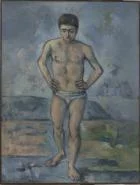
A highlight of the exhibition is the exceptional loan of Cezanne’s The Bather (circa 1885) from the Museum of Modern Art in New York. This piece will be displayed alongside Peter Doig’s modern interpretation inspired by Cezanne. This pairing vividly illustrates the ongoing dialogue between artists across generations, transcending the traditional boundaries of time and style. Doig’s reference to encountering “Cezanne’s strangeness” elucidates the complex allure that Cezanne’s work continues to exert. It’s this captivating ambiguity that makes Cezanne's art so compelling, drawing contemporary artists to continuously re-envision his expressions for a new audience. And this is the part most people overlook: the living, breathing quality of his art and its ability to spark fresh insights.
Legacy and Continuity
The exhibition will also display Cezanne’s depictions of geological forms, specifically featuring his renditions of Mont Sainte-Victoire from notable collections. This focus transcends a mere study of Cezanne’s techniques; it investigates how contemporary artists like Fabienne Verdier and Mark Tansey have internalized Cezanne’s vision and reinterpreted it in their practices. The continuous conversation initiated by Cezanne's work is vital to understanding modern artistry. His approach to color, form, and perspective leaves an indelible mark on art that goes beyond representation.
By weaving these elements together, "Cezanne and Us" becomes more than a celebration of the artist's life; it’s a vital examination of the profound and lasting impact Cezanne has had on the art world. His work remains relevant as artists grapple with and respond to his formidable presence in the art historical canon. If you're working in this space, you'll find that Cezanne’s influence is something that can inspire and provoke thought, pushing the boundaries of contemporary and modern art.
Implications and Future Outlook
The significance of this exhibition extends beyond mere historical recognition; it resonates with current discourses in art today. Cezanne’s ability to bridge past and present offers a framework for artists who seek to innovate while remaining rooted in a rich artistic tradition. As institutions continue to spotlight the interconnectedness of artistic movements, "Cezanne and Us" paves the way for future exhibitions that strive to curate cultural dialogues rather than isolated narratives. The enduring popularity and relevance of Cezanne's work suggest that, as art continues to evolve, the echoes of his influence will remain a crucial part of how artists approach their craft. The takeaway? Art isn’t static. It evolves as we do.
• For more information, visit the official exhibition page for Cezanne and Us ongoing until January 17, 2027, at Grand Palais, Paris.

Discussion
Sign in to join the discussion.