Ai Weiwei's new installation in Sydney, featuring 500 cast-iron helmets, critiques modern leadership and humanity's precarious sense of security.
A Stark Reminder of Humanity’s Vulnerability
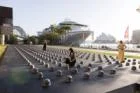
Ai Weiwei's latest installation, titled Mushrooms, presents a powerful commentary on modern society's fragility. Comprising 500 cast-iron combat helmets arranged in ten uniform rows, the artwork debuted on September 25 outside the Museum of Contemporary Art Australia. This installation, part of the Neil Balnaves Tallawoladah Lawn Commission, will remain on display for a seven-month period, inviting viewers to engage deeply with its themes. The visual impact of the piece—rows of cold, metallic helmets—evokes not just military conflict but the broader implications of security and survival in a precarious time. The choice of materials speaks to a certain durability yet highlights the stark contrast with the vulnerability of human life.
The Concept Behind 'Mushrooms'
The inspiration for Mushrooms stems from an incident in February 2022 when Germany offered 5,000 helmets to assist Ukraine amid mounting tensions with Russia. This gesture sparked widespread mockery, underscoring a disconnect between political action and human needs. Ai asserts that the piece is not just a political commentary; it embodies a critique of contemporary leadership's superficial grasp of human realities. Politicians often employ symbols and gestures that suggest action without addressing underlying issues, leading to a political environment that feels disassociated from the people it claims to serve. The absurdity of sending helmets as assistance starkly contrasts with the complex, multifaceted nature of conflict that requires more than just protective gear.
Exploring Themes of Uncertainty and Reflection
In his discussion of Mushrooms, Ai Weiwei conveys a profound sense of apprehension about the future. He argues that civilization, as we understand it, is precariously built on foundations that could easily be disturbed. “What we call civilization today... can disappear within a very short space of time,” he expresses, highlighting the contrast between our current potential and the pervasive state of uncertainty facing humanity. This volatility is not new, yet it feels amplified by recent global events—climate crises, political polarization, and social unrest. The artwork becomes a mirror reflecting these concerns, prompting viewers to confront the fragile status quo rather than overlook it in favor of more comforting narratives.
A Personal Influence
Ai's reflections are deeply personal, influenced by the life of his father, the poet Ai Qing, whose struggles for truth and expression under oppressive regimes shaped his worldview. The challenges faced by his father resonate through Ai Weiwei's work, emphasizing that the need for free expression is a poignant form of resistance. This yearning for truth holds particular relevance during periods of socio-political turmoil; when dissent is often met with suppression, art can serve as an outlet for voices that seek recognition and validity. This lineage of thought informs Mushrooms, anchoring the installation in a history of artistic activism. It’s through these personal experiences that Ai communicates larger societal struggles—his art is a bridge between individual and collective histories.
Value Systems in Flux
Ai Weiwei broadens the context of his artwork, discussing how rapid developments in technology, including artificial intelligence, are reshaping societal values. He contemplates the implications of these shifts on trust, belief, and the relationship between individuals and society at large. "These value systems... challenge many of humanity’s existing systems of values," he notes, indicating a turbulent intersection of innovation and ethics. What we once understood about privacy and interpersonal connections is increasingly in flux, leaving individuals to navigate a world that often prioritizes efficiency over empathy. This technological whirlwind poses the question: as our tools evolve, are we prepared to reassess the values that bind us as a society?
Continuing Legacy of Artistic Expression
This installation follows last year’s commission by British artist Thomas J. Price, which featured a striking bronze sculpture. Mushrooms not only builds on this tradition but also elevates the discourse surrounding art as a medium for exploring complex societal issues. It stands as a testament to Ai Weiwei's ongoing commitment to confronting pressing global challenges through his art, urging observers to reflect on their own values and the world around them. This commitment invites an active engagement; art, in Ai's view, isn't merely for admiration but a call to action and introspection.
Implications and Future Outlook
As Mushrooms continues to draw viewers in Sydney, it serves as both an artistic expression and a catalyst for dialogue about the future of humanity. Ai's message, steeped in a historical context of struggle for autonomy and understanding, resonates as poignantly relevant in today's uncertain world. The implications of his work reach beyond the installation itself, challenging audiences to reconsider how they engage with pressing societal issues. If you're working in this space—be it art, politics, or social activism—you’ll find that the conversation Ai initiates through this installation extends far beyond the immediate visual experience. The future of artistic expression may well revolve around being not just observers but active participants in the ongoing discourse of humanity.

Discussion
Sign in to join the discussion.