Sutura brings more than 100 artists to 20 venues across Ciudad Juárez and El Paso, exploring the border as a shared, lived experience.
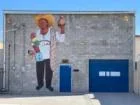
Azul Arena’s façade in Ciudad Juárez carries ¡Pásele, pásele!, a mural by LxsDos. The invitation feels apt for Sutura, a new binational art programme running from 18 to 22 November across Ciudad Juárez, Chihuahua, and El Paso, Texas. Its premise is more ambitious than a run of exhibitions: can art help stitch together a border region routinely reduced to stories of violence? The answer Sutura offers is tentative. A suture may hold, at least for a while.
Courtesy of Azul Arena, 2025
Sutura—Spanish for “suture”—brings together more than 100 artists at 20 venues, from the El Paso Museum of Art and the Stanlee and Gerald Rubin Center for the Visual Arts to the Museo de Arte de Ciudad Juárez. Independent projects and pop-up shows fill out the programme. The scale matters, but the more telling choice is its attempt to look past the familiar shorthand of a border defined only by danger.
A border lived in common
Ciudad Juárez has been framed for years through migration, increasingly strict border controls and deportation measures, feminicides, the drug war and surveillance. Those realities shape the place, and they have shaped its cultural production. But Willivaldo Delgadillo has warned against turning Juárez into a forecast of catastrophe: in his 2020 book-length essay Fabular Juárez, he writes that “endless works have explored this territory as a symbol and symptom of an apocalyptic future.”
The history between Juárez and El Paso complicates any easy story of separation. The cities were one until the Rio Grande became the boundary between Mexico and the United States in 1848. Their countries have since been marked by tension, yet the cities remain connected through education, employment and transit.
“On each side of the border, nuanced and contrasting fears and ideologies coexist, but there is also community,” says Edgar Picazo Merino, Sutura’s founder and lead organiser. “For all of us who live here, the border is a personal, lived experience.” Picazo founded the independent initiative Azul Arena in 2019 to support the Juárez–El Paso art scene; it opened a permanent space in Juárez in 2022.
One influential way of describing the border comes from Chicana writer Gloria Anzaldúa. In 1987, she called it an “open wound”: “The Third World grates against the first and bleeds,” she wrote, imagining two worlds merging into a “border culture.” The metaphor has become familiar in writing about the region. Sutura’s question is what happens if artists treat that wound as something to work on: “If the border is a wound, how can the arts suture its many wounds, while opening places of reflection and interaction?” Picazo asks.
Justin Favela’s Mantecore (White Tiger) (2017), shown in the group exhibition Qué tanto es tantito at San Luis Contemporáneo in Ciudad Juárez.
Courtesy Haydee Alonso
Building on regional ties
Sutura joins a longer history of cross-border art initiatives. Insite began in 1992 at the San Diego–Tijuana border with site-specific installations, then changed formats over time. Closer to Juárez and El Paso, the Border Biennial was launched in 2008 by the El Paso Museum of Art and Museo de Arte de Ciudad Juárez. Its eighth edition, Imagining the Border, runs through 2 May 2027. Co-curated by Juárez-based curators Adriana Miramontes Olivas and Alejandro Morales, it brings together more than 80 works by artists based within 300 miles of the two cities.
“A border that is always there, one that weighs heavily on our communities, rarely lets us imagine it,” Morales says. “This edition opens that space, offering a plural and rigorous portrait of it as living territory.”
Edward Hayes Jr, director of the El Paso Museum of Art, says the biennial challenges the image of a border perpetually “on fire” by drawing attention to its creative life and cultural legacies. He also points to the diplomatic and logistical work required to make the project happen. For Christian Diego Diego, director of the Museo de Arte de Ciudad Juárez, the goal is to make the biennial a lasting structure for both institutions. Across its past and current editions, Diego says, it has presented more than 400 works by around 270 artists, tracing the region’s “ambivalence and multiple stories.” Sutura’s programme includes visits to the biennial, creating space for exchange with its artists, curators and venues.
The idea for Sutura grew from a more practical question: what could an art week in Juárez and El Paso look like? Such events are emerging elsewhere along Mexico’s northern border as organisers seek to decentralise an art scene still largely focused on Mexico City. Tijuana held its second art week in July; Mexicali staged its first in April.
Material art fair has supported Azul Arena and the Juárez curatorial duo Un Dique through its two-year Projects programme, offering mentorship and free participation in its Mexico City and Guadalajara fairs. Un Dique is part of Sutura with Border Kaijus, an exhibition about border hypervigilance.
“There is a growing scene among border Mexican cities with spaces and initiatives interacting,” says Andres Payan Estrada, director and chief curator of the Rubin Center and Sutura’s artistic strategy director. Still, he draws a clear distinction between this project and a commercial art week: “It is a non-commercial collaborative initiative with a strong community component.” That difference is central to Sutura’s pitch. Its success will depend less on the number of venues than on whether the collaboration lasts beyond the programme dates.
Installation view of Costuras Territoriales at the Stanlee and Gerald Rubin Center for the Visual Arts, University of Texas at El Paso.
Courtesy of the Stanlee and Gerald Rubin Center for the Visual Arts at the University of Texas, El Paso
Art made from local material
El Paso’s institutions have a prominent role in the programme. The Rubin Center presents Costuras Territoriales through 12 December. Curated by Payan, the exhibition brings together textile-inspired work by five women artists with ties to the border, including Teresa Margolles, Tania Candiani and Juárez-based Olga Guerra.
“The way in which artists explore the border has sometimes become a cliché,” Guerra says. Her response is to approach connection through poetry, using organic materials and fibres found locally alongside reused materials. It’s a grounded way to address a heavily symbolised place: start with what is there, and with the relationships people build around it.



Discussion
Sign in to join the discussion.