Interwoven brings nearly two dozen artists together to stretch basketry across ceramic, steel, paper and unexpected materials.
Basketry as an artistic language
Interwoven: Basketry As Expanded Practice treats basketry as an artistic language that can move beyond the familiar vessel. Opening November 29 at Mindy Solomon Gallery in Miami, the exhibition brings together nearly two dozen artists working across sculpture, painting and installation. The premise is straightforward, but it has consequences: once weaving is separated from the expectation of making a container, it can become a way to organize surfaces, connect materials or build volume.
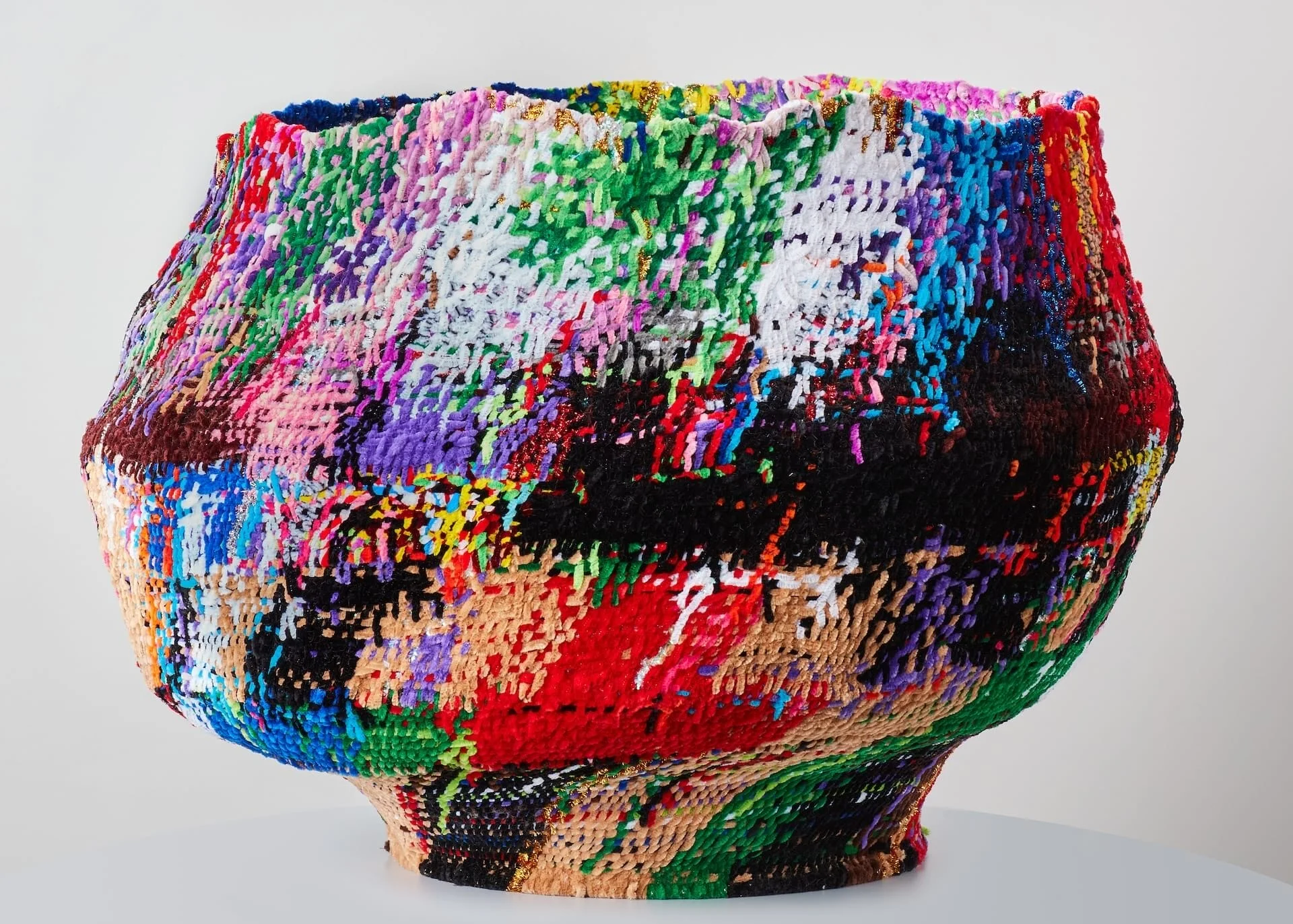
Curator Dee Clements frames the show around a question: what becomes possible when basketry isn’t confined to a fixed craft category? The works answer with materials ranging from ceramic and steel to cotton and paper. Salvador Dominguez builds vivid vessels from pipe cleaners; Eric Gushee interlaces wire into wall sculptures; Miguel Arzabe cuts apart paintings and weaves them back together. These examples make the exhibition’s argument visible in different ways, from a familiar vessel made with an unconventional material to painting treated as something that can be physically restructured.
That breadth also puts pressure on the word “basketry.” The term can refer to a recognizable object, a set of hand techniques or a more general logic of crossing and joining. Clements’s framing favors the latter, asking viewers to recognize weaving where the result may not look like a basket at all. That’s an expansive approach, though it asks the exhibition to show that its connections are more than a shared visual motif.
Materials reshape the form
Some artists draw on materials far removed from traditional basketmaking. Dienke Dekker combines artist paper, painted cane and waxed cotton cord in geometric forms. José Santiago Pérez uses Mylar emergency blankets and craft lacing for First Portal (Healer’s alter seven generations ago), a teal wall work made in 2021. Dee Clements pairs ceramic with woven reed and dyed basswood in Crone. Each combination changes the balance between flexibility and rigidity, and between a material’s everyday associations and its role in a constructed artwork.
The material choices matter because they keep the show’s central claim from becoming purely abstract. Cane and cord make the connection to basketry legible; paper, ceramic and emergency blankets complicate it. In Pérez’s work, the pairing of a reflective survival material with craft lacing gives weaving a role in shaping a wall piece, rather than simply decorating it. Clements’s combination of ceramic, reed and basswood likewise places a traditionally pliable process beside materials that hold their form differently.
The exhibition also includes Xanthe Somers’s glazed stoneware sculpture Never an end to holding, a large ceramic form with a woven appearance, and Sonia Barrett’s Desk 10, which brings willow and netting into a work built around a Chinese lacquer desk. Together, these pieces make basketry feel less like a technique tied to one material than a set of decisions about structure, repetition and connection. Somers’s ceramic form suggests a woven surface while using a material that behaves differently from cane or willow; Barrett’s work places woven elements in relation to furniture, bringing the technique into an object with its own established function and visual history.
Where craft categories meet
That shift gives the show its strongest point of view: weaving can shape a painting, alter a piece of furniture or turn unexpected materials into sculptural forms. The works don’t abandon basketry’s hand-built logic; they carry it into new contexts. This is more significant than it looks, because craft categories often influence how viewers interpret both a process and the status of the finished object. Here, the exhibition asks audiences to consider how much of basketry lies in the object itself, and how much lies in the act of making connections.
There’s a useful tension in that question. If nearly any repeated crossing of materials can be read through basketry, the category risks becoming so broad that it explains little. The exhibition’s more persuasive examples are those where the woven structure has a clear role in the work’s form or construction, whether it binds separate elements, reshapes a surface or creates the impression of a vessel. (And this is the part most people overlook.) The material experiments are not only about novelty; they test how far a process can travel while still remaining recognizable.
What the exhibition leaves open
Interwoven runs in Miami through January 9. Its range suggests that the next chapter of basketry may be defined less by what a basket holds than by what weaving can make possible. That proposition leaves room for disagreement, which is healthy for an exhibition organized around an expanded category rather than a settled definition.
If you're working in this space, the show’s most useful question may be practical: what does weaving contribute to a work that another process couldn’t? The answer will vary across painting, sculpture and installation, and the exhibition’s range gives viewers several ways to test it. Not a single vessel in sight of the category’s limits.



Discussion
Sign in to join the discussion.