The planned museum will bring together 120 works by Mario Sironi, but historians say its interpretation must address his support for Mussolini.
A major collection, with a contested legacy
Rome’s planned Mario Sironi museum will bring 120 works by the Italian Modernist into a state-run institution. The collection spans more than four decades of his career, including work made under fascism. Historians say the museum’s account of that career will matter as much as the art on its walls, because the selection and interpretation will shape how visitors understand the relationship between Sironi’s artistic development and the political system that supported some of his most prominent commissions.
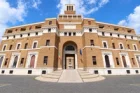
The culture ministry recently acquired 30 works from the Mario Sironi Archive in Rome, including paintings, drawings and preparatory sketches. The archive will lend another 90. Together, the works could let the museum show how ideas developed from study and draft to finished piece, rather than presenting only celebrated final works. The museum is expected to open next year in the National Association of War Disabled and Wounded Veterans, a monumental building inaugurated in 1928.
That setting carries its own history. The building contains two large frescoes Sironi painted in 1938; one depicts Benito Mussolini on horseback. The planned collection will cover Sironi’s Futurist beginnings, work influenced by Metaphysical painting and monumental commissions he received under the fascist regime. Placing these works in the same institution creates an opportunity to examine their connections, while making the choices about labels, chronology and interpretation unusually visible.
Historians want the politics made explicit
Sironi joined the fascist movement in 1919 and produced more than 1,700 political cartoons and illustrations for Il Popolo d’Italia, Mussolini’s newspaper. Yet the museum’s press materials do not mention fascism or Mussolini, prompting concern that the project could present the artist’s work without enough historical context. This gap matters because visitors cannot be expected to infer the political role of the work from its style alone, particularly when the museum itself is housed among commissions from the regime.
Tomaso Montanari, an art historian and rector of the University for Foreigners of Siena, supports the museum’s creation but says its educational material must clearly reject any endorsement of fascism. “Since Italy is a republic founded on anti-fascism, the museum's educational material must make clear that there is no endorsement of fascism,” he told The Art Newspaper. His point is about the museum’s public voice: collecting and displaying the work is one decision; explaining the circumstances in which it was produced is another.
Montanari also sits on the culture ministry’s scientific committee. He said the initial plan focused “overwhelmingly” on Sironi’s fascist-period work. After he argued for broader coverage, the ministry “partially” accepted the case for including works from other phases of the artist’s career. A wider chronology could make the presentation more informative, but breadth alone won’t settle the question of how directly the museum addresses the politics attached to particular works.
Fabio Benzi, an art historian and curator who serves on the museum’s scientific committee, voiced a related concern to Le Journal Des Arts: “The danger is of legitimising a certain authoritarian aesthetic under the guise of cultural rediscovery”. The warning points to a familiar problem for institutions presenting politically compromised art: admiration for formal achievement can become a way of softening the history around it. The museum’s framing will determine whether visitors can consider both at once.
The museum in a wider cultural setting
Culture minister Alessandro Giuli unveiled the plans on Tuesday, calling the project “the defining achievement of my term in office, and the one of which I am most proud”. That language gives the museum a prominent place in the ministry’s cultural agenda, while leaving open what its public interpretation will contain. The ministry has been contacted for comment.
The project arrives amid other efforts to present art and architecture tied to Italy’s fascist period. Last year, the ministry announced it had acquired the Rome home of Futurist painter Giacomo Balla, who initially supported fascism, and would operate it as a museum. On Thursday, 5 November, senior members of Giorgia Meloni’s government presented an exhibition marking the 90th anniversary of Rome’s EUR district, a prominent example of fascist-era urban planning. These projects differ in subject, but each asks cultural institutions to decide how historical associations should appear in public presentations.
Meloni’s Brothers of Italy has political roots in the postwar neo-fascist movement. That context makes the museum’s framing especially consequential: a collection that traces Sironi’s artistic shifts can also show how his work related to the politics and institutions of his time. The key test will be whether visitors encounter that history as part of the exhibition, rather than having to supply it themselves.
What visitors will be asked to see
The museum’s most consequential choices may be ordinary ones: where works sit in the galleries, what the captions say, and whether political cartoons and preparatory materials are presented alongside paintings and commissions. Those decisions can help visitors see Sironi’s career as a sequence shaped by both artistic change and political commitment. Or they can leave the political record at the edges of a story focused mainly on style.
This is more significant than it looks. A state-run museum doesn’t simply preserve an artist’s work; it gives that work a public account. If you’re working in this space, the practical question is whether the interpretation provides enough evidence for visitors to understand why the art was made and how it circulated. A wall label can’t answer every historical question, but silence about the regime would narrow the story before visitors have a chance to assess it.
(And this is the part most people overlook.) The collection’s range is useful only if its presentation helps viewers connect the phases of Sironi’s career, including the work tied directly to fascist institutions. More works can mean a fuller account. A fuller account requires context.



Discussion
Sign in to join the discussion.